


Leave your contact details and we will contact you
The spanish aviator. The Soviet roots of Epigen and other licorice-based products
Almost everyone knows the plant licorice and its characteristic sweet-bitter taste. As with olives, not everyone likes it: some recall with a shudder the taste of cough syrups from childhood, while others would happily eat a licorice gummy or lozenge today.
However, the use of licorice in the pharmaceutical industry is not limited to syrup alone. Back in the middle of the last century, scientists learned to extract glycyrrhizic acid from it, which became the basis for a whole range of drugs both in our country and abroad. And today one of the most interesting representatives of the "licorice" family is the Spanish Epigen Intim, whose sales in Russia are handled by the company Invar.
We tell the intricate story of a drug whose origins lie in Soviet development and in whose emergence even the last General Secretary and the only President of the Soviet Union, Mikhail Gorbachev, played a certain role.
Debating Tastes
Licorice lozenges or gummies are an extremely popular treat in many countries of Northern Europe. Outside this region, they are rather exotic, and many consider the taste of licorice extremely unpleasant. For example, among RNC Pharma employees, opinions on the taste of licorice were split into completely opposite camps. And yet this taste is familiar to almost every one of us.
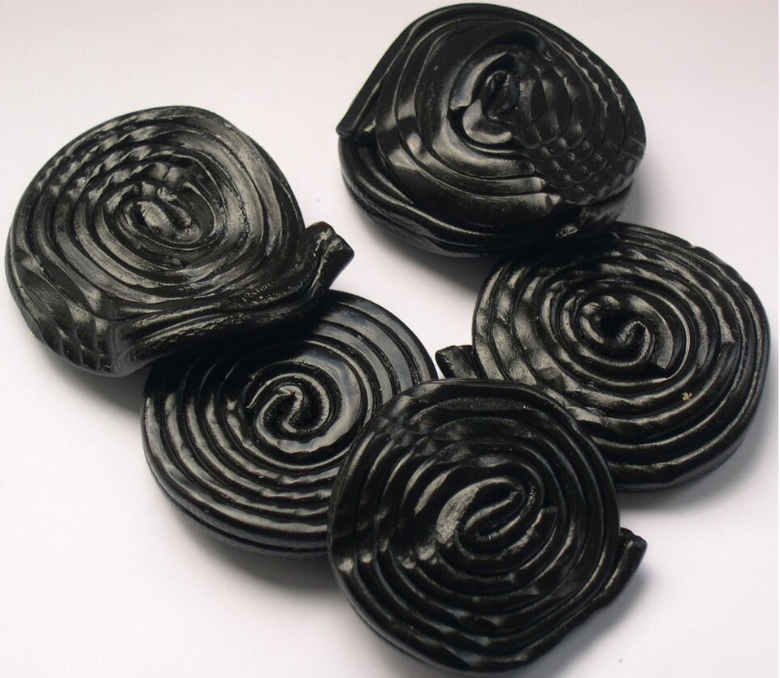
Traditional form of licorice candies. Source: Wikimedia
Licorice syrup is one of those remedies that many remember from childhood: a thick, sweetish liquid with a characteristic taste that parents gave for coughs. It is obtained from licorice roots — a fairly large perennial plant of the Fabaceae family that can reach a height of 1.5–2 m. Its main active components are glycyrrhizic acid and its salts. The drug has an expectorant effect and is traditionally used for respiratory diseases accompanied by cough.
However, licorice's role in medicine is not limited to lozenges and syrup. The glycyrrhizic acid contained in its roots possesses a number of valuable biological properties that have long attracted the attention of researchers. In particular, its antiviral, anti-inflammatory, and immunomodulatory activity is being studied. Based on this substance, drugs have been developed for use not only in respiratory diseases but also in dermatology, gynecology, and other areas of medicine.
Historically, Soviet scientists played a very large role here. In the USSR, in particular, there was active work on developing methods for extracting glycyrrhizic acid from plant raw materials. As early as 1961, an application was filed for the corresponding invention, and in 1962 publications appeared devoted to its medical use. One of the drugs created on the basis of glycyrrhizic acid was Glycyram — an ammonium glycyrrhizinate drug.
Unlike licorice syrup, Glycyram was used not only as an expectorant. It has an anti-inflammatory effect and stimulates adrenal cortex function. The drug entered medical practice in the mid-1970s: it was used for bronchial asthma, eczema, allergic dermatitis, and certain conditions associated with adrenal insufficiency.
Today, oral forms of ammonium glycyrrhizinate are still present on the domestic pharmaceutical market. However, there is another drug based on this component, whose history unexpectedly takes us far beyond Soviet pharmacology.
Spanish Adventures in Russia
Spain can hardly be mentioned among the leading players in the global pharmaceutical market. Although the country has a very large domestic market and substantial exports, there are no companies with Spanish "registration" that are notable on international markets, and production is represented mainly by sites of multinational corporations and local manufacturers. There are relatively few Spanish-made drugs in Russia either, but there is one very noteworthy exception.
The drug Epigen Intim is intended for topical use in viral infections of the skin and mucous membranes, primarily papillomavirus infection and genital herpes. Its active ingredient is so-called activated glycyrrhizic acid, equivalent to ammonium glycyrrhizinate. In other words, the Spanish drug is based on a compound well known to Soviet pharmacology since the 1970s.
The marketing authorization holder in our country is the Russian company Invar, whose history is also quite remarkable. It was founded back in 1991 by entrepreneur Ralph Weintraub. Initially, this company was engaged in investment consulting and had nothing to do with the pharmaceutical industry, working on projects in construction and the automotive industry. Oddly enough, the emergence of this business was inadvertently facilitated by the last General Secretary of the CPSU Central Committee and concurrently the first and last President of the USSR, Mikhail Gorbachev. In one interview, Ralph Weintraub mentioned that he had studied in Germany under a management and entrepreneurship training program as part of one of Gorbachev's political agreements with German Chancellor Helmut Kohl. The experience and business contacts that Weintraub gained during his training undoubtedly provided certain opportunities for developing a business in Russia.
In 1993, Weintraub was approached by the Spanish company Cheminova International, which was looking for a partner to bring its cosmetic line to the Russian market. Weintraub found the product so interesting that Invar did not limit itself to providing consulting services but also took on the registration and distribution of the new product. Thus, in 1997, the brand Epigen Intim appeared on the Russian market, and it continues to exist quite successfully today.
Almost thirty years later, Invar remains the marketing authorization holder in Russia, but the partner is no longer the Spanish Cheminova International but the French Chemigroup. Production, however, remains on the Iberian Peninsula: the manufacturer indicated in the Russian registration documents is the Spanish B.Braun Medical S.A.
In our country, according to the "Retail Audit of Drug Sales in Russia (total sell out)" from the analytical company RNC Pharma, the total retail market for ammonium glycyrrhizinate drugs in January–October 2026 exceeded RUB 1 billion. In total, pharmacies sold about 641,000 packages of such drugs. The basis of this conditional category is made up of topical products, among which the absolute leader is Epigen from Invar. Since the beginning of this year, pharmacies have sold 204,000 packages of this drug worth RUB 608.6 million (at retail prices, including VAT). However, competitors have recently been appearing, including Ginokair from Binnopharm and Glicevir from Vifitech, which together account for sales of about 55,000 packages worth RUB 71.6 million. Oral dosage forms of ammonium glycyrrhizinate are also important; here the main volume is provided by Reglisam from Vifitech — in the first 10 months of this year, the company sold 391,300 packages of this drug worth RUB 331 million.
A Detective Story
There are several blank spots in the drug's history. The first, of course, is its origin — specifically, the possible connection with domestic developments of the 1960s–1970s. It is impossible to answer unequivocally whether Epigen has Soviet roots. On the one hand, the USSR was the world's largest exporter of licorice roots and extract. Our country had a very deep scientific school and a colossal industrial base for the procurement and processing of this valuable biological raw material, which was very widely used not only in pharmaceuticals but also in other industrial sectors as a foaming agent. On the other hand, glycyrrhizic acid-based drugs existed not only in the USSR; similar research was conducted in Japan.
Undoubtedly, Spanish researchers studied the existing work of Soviet specialists very thoroughly. It is quite likely that raw materials from Turkmenistan and Kazakhstan, where the main procurement and processing enterprises of the all-Union production association Soyuzlakritsa were concentrated, were also used for production needs in the early stages. However, at present, Chinese suppliers appear as the raw material suppliers for Epigen and its domestic analogues.
Moreover, the choice of Russia as a promising market for the new drug back in 1993 is quite notable. Furthermore, judging by some documents, Russia also became one of the first sites for clinical trials, along with Spain itself and Mexico.
The situation with the drug's sales geography is no less interesting. Despite the "Spanish trace," Epigen is not very widespread on world markets. Moreover, according to a number of sources, its main sales market is primarily Russia and the CIS. It is also sold in some Eastern European countries and, to a limited extent, in the Middle East.
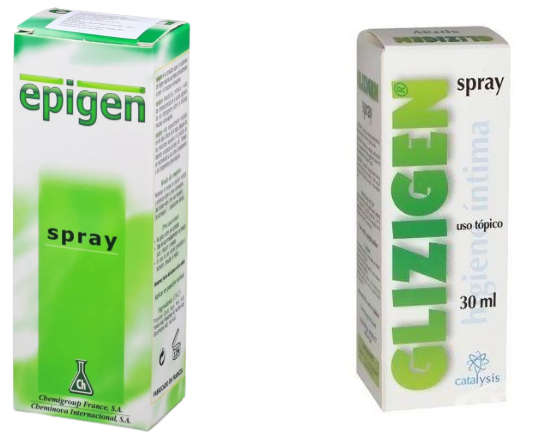
Packaging of the drug Epigen spray from Chemigroup France and Glizigen from the Spanish company Catalysis
In addition, Epigen has a twin — Glizigen, produced by another Spanish company, Catalysis, for international markets. It is available in the same dosage forms, has the same main active ingredient — glycyrrhizic acid — and similar indications for use. Moreover, in some scientific publications, Glizigen and Epigen appear as names for the same product.
Catalysis is directly connected with Cheminova, and the circumstances of this connection are quite remarkable. In 1997, Cheminova became embroiled in a major scandal over its cosmetic line Skin-Cap. Spanish regulators demanded the withdrawal of the products from circulation after clobetasol was found in their composition, which was not disclosed on the packaging. This put the company's entire business at risk, since Skin-Cap was its main asset.
Against this backdrop, a rather strange change of legal entities occurred. On December 1, 1997 — less than two months after the withdrawal of Skin-Cap began — Catalysis was registered. Soon the company began producing a virtually identical line of products under the name Blue-Cap: spray, cream, and shampoo. The composition of the owners and management partially overlapped with the predecessor company.
In November 2002, the Spanish Cheminova Internacional S.A. was officially declared bankrupt. Some former shareholders tried to challenge the actions of the Spanish regulators that led to the withdrawal of Skin-Cap from the market, but these efforts were unsuccessful.
It is now quite difficult to reconstruct a reliable picture, but there was probably a rather complex scheme involving the redistribution of commercial interests and rights to the company's products. Skin-Cap represented the main commercial interest, so the business line associated with it continued in Catalysis, which was formally unrelated to the scandal surrounding the original product. By that time, Epigen had been launched in only a few regional markets, and the rights to the brand in Russia ultimately ended up with the French Chemigroup. At the same time, on other European markets, the analogous product began to be promoted by Catalysis, but under a new name — Glizigen.